Maritime Cyber Security
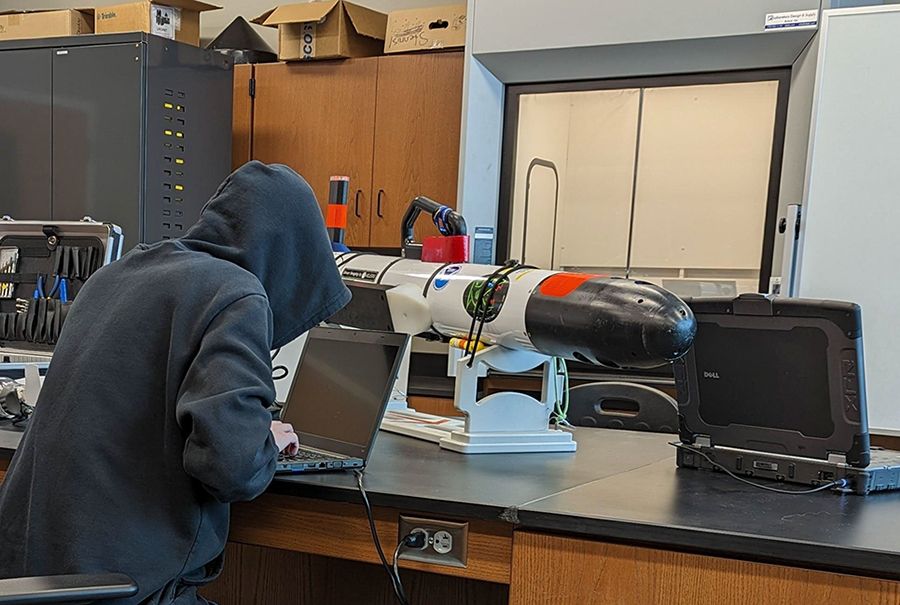
Maritime Cyber training provides an overview of vulnerabilities, threats, and risks. It delves into specific challenges the Uncrewed Maritime System (UMS) industry faces.
REQUIREMENT: You must be a U.S. Citizen to take this course. Contact the instructor for verification and access: maritimetraining@usm.edu
REQUIREMENT: You must be a U.S. Citizen to take this course. Contact the instructor for verification and access: maritimetraining@usm.edu
-
Program Learning Objectives
- LO1: Discuss purpose and significance of cybersecurity and key elements of securing digital information.
- LO2: Describe the modern threat landscape and discuss importance and broader impacts.
- LO3: Understand malware and why securing systems against it is important.
- LO4: Define authentication, commonly exploited security controls, and solutions to mitigate issues.
- LO5: Discuss purpose of encryption, challenges involved, and types of protections.
- LO6: Discuss common operating systems, applications, and sub-systems involved in cybersecurity and why it is important to secure them.
- LO7: Explore cybersecurity standards, frameworks, prevention measures, and resources
- LO8: Explore common UMS communication methods and protection measures that are crucial for maritime cybersecurity.
- LO9: Describe the modern maritime threat landscape and discuss importance, impacts, and key elements.
-
Desired Outcome for Learners
- Ability to define cybersecurity, recognize its significance, and identify primary elements of information protection. Ability to define threat actors, level of impact, and identify common attacks.
- Ability to recognize key features of malware attacks and types of malware.
- Ability to identify how authentication works and types of authentication methods.
- Ability to recognize encryption solutions and challenges.
- Ability to identify common operating systems, applications, and sub-systems and protection measures.
- Ability to identify, use, and share cybersecurity standards, best practices, and resources.
- Ability to identify, use, and share cybersecurity standards, best practices, and resources.
- Ability to define maritime cybersecurity and Uncrewed Maritime Systems, and apply significance to broader maritime infrastructure.
- Ability to define UMS communication methods, network traffic, and prevention solutions.




What's included?
-
Pre-Assessment Survey
-
13 Online Modules
-
13 Knowledge Checks
-
Summary Documentation
Online Format
Participants learn the fundamentals of Machine Learning (ML) and explore various ML model performance using GUI-based (in the introductory and intermediate stages) hands-on case studies and R and Python languages (in the advanced stage).
Interactive Classroom
After completing the online section, participants can schedule an interactive classroom experience. Our experts help participants execute what they learned in the online course material to create customized interactive dashboards for climate change and oceanographic analysis using Tableau (in the introductory and intermediate stages) and code/deploy end-to-end ML pipelines (in the advanced stage).
Meet the Director of RDT&E and Training
Jason R. McKenna, Ph.D., PG
Dr. Jason McKenna is the director of research, development, testing, evaluation and training (RDTE&T) at the Roger F. Wicker Center for Ocean Enterprise
Patrick Jones - Course author
Course Lessons
Ocean Enterprise, USM Marine Research Center, 1030 30th Avenue, Gulfport, MS 39501
Phone number: 228-214-9010
Phone number: 228-214-9010